Friday, 16 December 2011

Sura (Bubur Asyura)

Aunty Ina made this Sura at home. This Sura is very sweet and soft - it hadn't set yet. She had used the usual stove and not kawah.


There's a story to go with Sura (Bubur Asyura). Read about the story of Nabi Nuh a.s.

Monday, 31 October 2011

Peria katak for gout

I was watching a YouTube video and the crew visited the fresh market. A lady pointed to peria katak, medium-sized bittergourd. She said she had problems with her joints and sought help from her friends. Somebody told her to take juice from the small bittergourd. She tried taking juice extracted from peria katak and her joint pains disappeared and she was happy.

I visited the fresh market at Pulau Melaka and asked a stall owner about peria katak. There were 2 types of bittergourds (peria) that I saw - a medium and a small variety. The normal size one is referred to as peria. The small (almost) rounded bittergourd is called peria katak or frog bittergourd.

What a surprise! The lady in the YouTube video pointed to the medium-sized bittergourd as peria katak. Now the stall owner tells me, peria katak is actually the small rounded bittergourd, (and which resemble frogs!).  The peria katak is a small bittergourd, almost rounded and with pox-like skin. The peria katak resembles a frog, maybe a bullfrog!


Normal long soft peria (bittergourd) for blanching and frying.

Unusually small hardy peria katak (frog bittergourd) which the Malays use for controlling diabetes (kencing manis)

Sunday, 30 October 2011

Kelantan salads (ulam)

Kelantan is very special when it comes to eating raw vegetables which are called ulam. Most people in Kelantan eat ulam daily and at every meal, whereas Malaysians in other states do not take vegetables daily or regularly. It pays to take a close look at why Kelantan people like to eat vegetables.

Today, 30 October 2011, my husband and I went to visit some fresh markets in Pulau Melaka and Binjai after work. It was drizzling which made the weather cool and I enjoyed my time out visiting the vegetable stalls and asking the stall owners. It feels good to talk to them as they are knowledgeable about the vegetables they sell.

Here are some interesting raw vegetables and salad greens or ulam in Kelantan.


Clockwise starting at 6 o'clock: Ulam for making nasi air/nasi bubur, tied bunches of praddee (looks like dandelion) and ulam pegaga 

The fruits are pauh ringan (small green unripe manggo) for making preserved manggo or shredded to make kerabu mangga, an appetizer. At the top are tied bunches of bendih (lady's fingers). At right are daun selom (top right) and praddee (Thai, bottom right) 

Back row from left: Kacang botol (four-angled bean), peria (bittergourd), jering, dried fish and limes in blue tray, and terung (small brinjals for ulam). Middle row: Medium terung, timun susu (young small cucumber for making jerkin) and praddee. Front row: Packaged blocks of ubi kayu - ready to boil, bunches of bendih (lady's finger) and daun selom. 

At left: Packs of small red cili padi (fiery hot chilies) for eating raw with budu or pounded/blended to make sambal. Foreground: Bunches of kacang botol. At the top are peria (the normal bittergourd) 

Bunga kunyit is actually flowers or florets from the temu lawak plant. Temu lawak resembles kunyit (tumeric) and smells of kunyit but it is used as a salad, ie eaten raw. This is the flower/florets from the temu lawak plant, and bunga kunyit is a misnomer but the flowers/florets are fragrant and smell like tumeric. These flowers/florets are edible and best eaten raw. Better still when the florets haven't fully bloomed. You eat the whole thing, including the white stems. They are really fresh and wonderful to eat raw. Just ask for "bunga kunyit" the next time you go to the market. They sell for RM2/bunch of 3 flowers/florets. 

Daun selom. From my first-year botany class, I think this is an ancient plant. It grows well in water and has a hollow stem. It is eaten raw and is crunchy. 

Daun serai kayu. These are fragrant leaves from quite a big tree. The leaves are shiny, waxy and have a thick look. They are actually paper-thin and feather-light leaves. They are shredded raw and used for making nasi kerabu etc. 

Ulam Raja. This is the most expensive salad or ulam. History has it that this salad was once served only for kings and normal people cannot take this salad. Nowadays, everybody is allowed to eat this salad. The plant resembles the poppy plant and has small golden flowers. It grows wild in sandy soil and only needs occasional watering. It propagates by seeds which are dispersed from the dried poppy flowers.

Praddee. This is a Siamese salad. The entire plant can be eaten (minus the roots), including the thick stems. It is crisp and eaten raw but can be cooked. It has short white roots and leaves of different shapes. It had small clusters of green flowers. This is a unique plant and I have never seen this plant before. It costs RM1/bunch. It is available from a stall at the Binjai junction. 

Fresh Kelantan salad/ulam 

Boiled Kelantan salad/ulam 

Saturday, 24 September 2011

Kelantan Breakfast

Kg Chicha Breakfast Medley

This is a lovely "vegetarian" breakfast for those who prefer some meat and more vegetarian taste. This is more like a Mediterranean dish but I made it at home in Kg Chicha. I made it for breakfast. I have not tasted it anywhere else. This recipe is original and really tastes good. Please try it.

Ingredients
2 large tomatoes (do not use the sour variety)
1 large white/yellow onion (use China/Holland/Belgian onion. Do not use red Bombay onion)
1 cucumber/ 1Cup mushroom (version 1 uses cucumber; version 2 uses frozen mushroom)
1-2 tablespoon ground beef (approx. 2in x 2in frozen ground beef)
1 Tablespoonful chopped spring onion (daun bawang)
<1/2 teaspoonful Oregano (use coarse Oregano, not powdered Oregano; use sparingly)
<1 teaspoonful fine salt (use less if possible)
<1/2 teaspoon powdered white pepper (omit if you are allergic to pepper; use sparingly)
1 Tablespoonful cooking oil
1 teaspoon kicap HABHAL masin (any soy sauce will do)

Method
Wash and slice the tomatoes. Remove all seeds. Chop the tomato slices.
Wash and slice the onion. Chop the onion slices.
Wash and slice cucumber approx 1cm thick. Remove seeds. Chop the cucumber slices. 
OR Thaw and cut up mushroom.
Thaw ground beef in the microwave oven. Don't overcook.
Heat up kuali and add oil.
Fry ground beef till soft and cooked through.
Add chopped onion. Stir to cook till soft, transparent, and light brown.
Add chopped cucumber/mushroom. Stir to cook briefly.
Add salt. Stir.
Add chopped spring onion. Stir.
Add Oregano. Stir.
Add chopped tomatoes. Stir.
Add pepper. Stir.
Add kicap/soy sauce. Stir. [Adjust salt/soy sauce amount or ratio. Use less salt, more soy sauce.]
Switch off stove.
Scoop vegetable medley into a pretty bowl.
Serve hot with fresh hot toast or eat it as is.
Drink hot coffee with milk.
That's the best breakfast!
Bon appetite!


Basic ingredients for filling:

3 big tomatoes and 1 large onion 

1 large white Holland onion (bawang besar warna putih) 

Chopped white onion 

Chopped tomatoes 


Use one third of a ground beef sausage pack

Thaw the ground beef in the microwave oven (don't overcook) 

Dried coarse oregano leaves, white pepper powder, and HABHAL salty soy sauce 

-------------------------------------------
Now decide whether to make v1 (plain filling), or v2 (cucumber) or v3 (mushroom) flavoured filling.

-------------------------------------------- 
v1 - Plain ground beef filling

Basic ingredients: 1 onion, 2-3 tomatoes, spring onion, celery, a third ground beef 

Basic ground beef filling 

================ 
v2 - Cucumber-flavoured filling 

Fry onion first till soft. Add ground beef and cook till tender. Add cucumber. Do not overcook. 

After adding tomatoes 

Colourful, delicious cucumber filling 

====================
v3 - Mushroom-flavoured filling

Frozen mushroom/Kulat putih @RM7.99/kg (12 Sept 2011) 

Fry onion. Fry ground beef. Add tomatoes and mushrooms. Do not overcook. 

Mushroom-flavoured filling 

Saturday, 3 September 2011

Cholesterol content of common foods

HEART DISEASE or STROKE?
If you have a choice, would you rather die from heart attack (myocardial infarct/MI or sakit jantung) or stroke (lumpuh)? If you eat high-cholesterol food, then it is more likely that you will die of heart attack. If you eat high-cholesterol & high-fat food, then it is more likely that you will get stroke first and for a few years, before you finally die of heart attack. Do you have a choice? Yes. 

CHOLESTEROL vs FAT
There is a big difference between cholesterol and fat. Both are lipids but they belong to different lipid classes and have different functions, with different outcomes. Both cholesterol and fat are essential (required in nutrition; kena makan). 

Cholesterol is a sterol, a special type of alcohol that is very stable in the body. Cholesterol is stable because it is a steroid, i.e., it contains the "steroid nucleus" - hexagonal rings A, B, C and D. We must eat cholesterol for hormone production and generation of new cells and tissues.

Fat can exist as solid (lemak) or as oil (minyak), depending on temperature (suhu). The scientific name for fat is triacylglycerols, but in medicine we call it triglycerides. Triglycerides contain fatty acids and glycerol. Some fatty acids are essential for life. Without the supply of essential fatty acids in the diet, babies die, children grow up with problems etc etc etc. 

WHERE IS CHOLESTEROL?
Cholesterol exists in all living cells. There is more cholesterol in animal cells, tissues and organs. Thus, animal products are said to be "high in cholesterol". On the other hand, products of plant origin are said to be "low in cholesterol". There is no such thing as "no cholesterol" if a product is made from living cells, tissues or organs. Sand, paper, cement, concrete, brick, glass, metal charcoal, activated charcoal, wood chips, BBQ blocks and water do not contain cholesterol but we can't eat these. 

HOW MUCH CHOLESTEROL IS IN FOOD?
Different food have different amount of cholesterol. Food can be grouped as "high-cholesterol", "medium-cholesterol" and "low-cholesterol". It is important to know the cholesterol content of the food we eat. This will help us know what to eat more and what to eat less. For better health, it is healthier to eat less of the dangerously high-cholesterol food and keep to the medium- and low-cholesterol food. If you are already eating lots of high-cholesterol food, then it is high time to make a switch and eat medium-cholesterol food. If you are already taking medium-cholesterol food and yet have health problems, then make a switch and eat low-cholesterol food. 

WHAT WILL HAPPEN IF WE TRY TO AVOID CHOLESTEROL?
Having very low cholesterol will make us ugly (tak cantik, tak lawa, tak menawan, buruk macam kayu). We must continue to eat cholesterol for hormone production and generation of new cells and tissues, and to look pretty (cantik manis).

RISK OF GALLSTONES
If we avoid all sources of cholesterol (and fat) for a long time, then we get another problem - gallstones (batu karang hempedu). Gallstone is very painful (sakit sebelah kanan). Gallstones are detected by ultrasound scan (pergi hospital dan buat ultrasound). Anyway, most people past age 50, have gallstone problem (ada batu karang hempedu). This manifest as feeling of bloatedness after meals (rasa kembung lepas makan, rasa senak, tak sedap duduk).

Rule #1: Avoid eating excessively high-cholesterol food.

Rule #2: Eat less high-cholesterol food and eat more medium-/low-cholesterol food.

Rule #3: Eat less medium-cholesterol food and eat more low-cholesterol food.

Rule #4: Eat generous amounts of low-cholesterol food for health.


HIGH-CHOLESTEROL FOODS
Makanan yang mengandungi tinggi tahap kolesterol
fat red meat (daging, daging berlemak)
organ meat (organ dalaman)
hard cheese (keju keras)
whole milk (susu penuh krim)
whole yoghurt (yogurt penuh krim)
cream (krim)
eggs (telur)
shellfish (kerang)
crab (ketam)
prawns (udang)
lobster (udang galah)
squid (sotong)
chocolate (coklat)
butter (mentega)
lard (minyak babi)
coconut oil
hard margarine 

Red meat (daging warna merah) - "high cholesterol" 

Red meat with fat (daging merah berlemak) - "high cholesterol and high fat" 

Kuah kurma/kormah - "high cholesterol", and "high fat" if ghee (minyak sapi) is used. 

Kerutuk daging - "High cholesterol and high fat" 

Kerutuk daging - "High cholesterol and high fat" 

Kerutuk daging - "High cholesterol and high fat" 

Kerutuk daging - "High cholesterol and high fat" 

Fried beef (daging goreng) - "High cholesterol and high fat" 

Fried beef (daging goreng) - "High cholesterol and high fat" 

Fried beef with soy sauce (daging goreng kicap) - "High cholesterol, high fat and high salt" 

Squids/cuttlefish (sotong) - "High cholesterol" 

Sambal sotong dengan petai - "High cholesterol" 

Udang - "High cholesterol" 

Masak lemak udang - "High cholesterol and high fat" 

Sambal udang - "High cholesterol" 

Eggs (telur): Egg yolks (telur kuning) - "High cholesterol"
1 egg = 250 mg cholesterol.

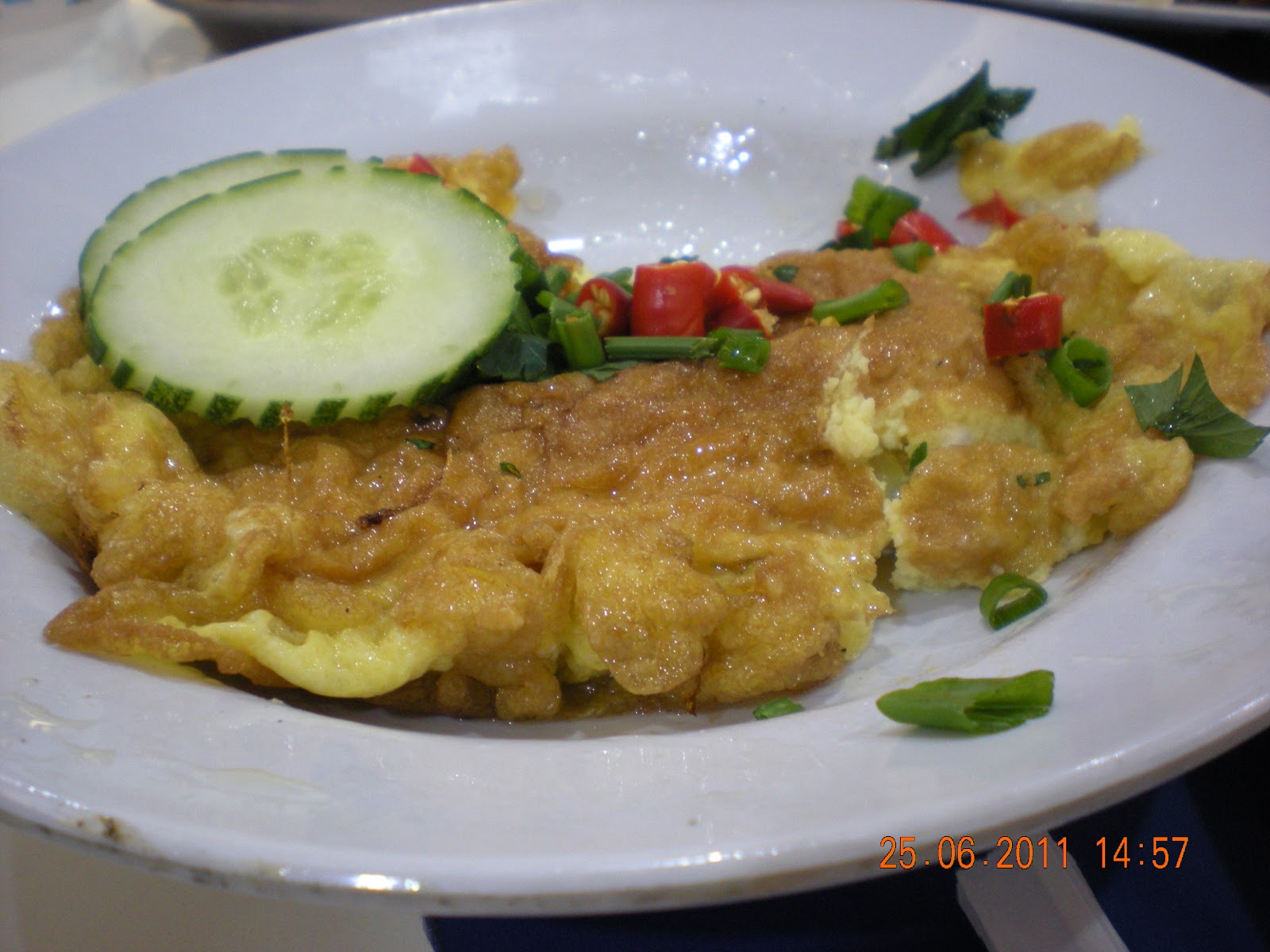
Omelette (telur dadar) - "High cholesterol" 

Half-boiled eggs (telur masak separuh) - "High cholesterol" 

Half-boiled eggs (telur masak separuh) - "High cholesterol".
Roti sapu marjerin - "High fat" 

Telur puyuh - "High cholesterol" 


MODERATE-CHOLESTEROL FOODS
lean read meat
soft cheese
ice-cream
cakes
pastries
mayonnaise
egg noodles (Maggi mee)

LOW-CHOLESTEROL FOODS
lean white meat (rabbit, turkey)
cottage cheese
soy milk
skimmed milk
low-fat yoghurt
fish
nuts
fresh fruits
vegetables
rice and other cereals
bread
vegetable oil
olive oil
corn oil
soft margarine


Source:
Adapted from an old pamphlet, Know Your Cholesterol, by Boehringer-Mannheim, Germany
Note: This leaflet is published as a service to Family Medicine.

External links:
https://www.hindawi.com/journals/cholesterol/2012/367898/